IT/OT convergence: the connection was the easy part
Gepubliceerd op 10 november 2026 in Industry 4.0
It helps to think in steps. Step one is separate IT and OT solutions, each built for stability and each doing its job in isolation. Step two, where many manufacturers still sit, is building interfaces so that data can flow between the two worlds. That is not nothing, but it is connectivity, not integration. Step three, which is happening now, is removing those interfaces altogether: a free flow of data, no bottlenecks, no file transfers between systems, and one consistent database from the start of the design process to the end of the manufacturing lifecycle.
With one consistent lifetime database, you can make real-time decisions on real-time data. You get closed-loop feedback that optimises production as it runs, and predictive maintenance built into the process rather than bolted on. It also means product design, machine design and production design can work from the same data. When introducing a new product, you can use model-based engineering and simulation to see how a change ripples through to the machines and the line before touching a single machine. That directly addresses what manufacturers tell us is their most pressing challenge: speed to market. It also gives them what they increasingly ask for, which is the agility to respond to change combined with the room to keep innovating. The value is end-to-end.
What it looks like on a real line
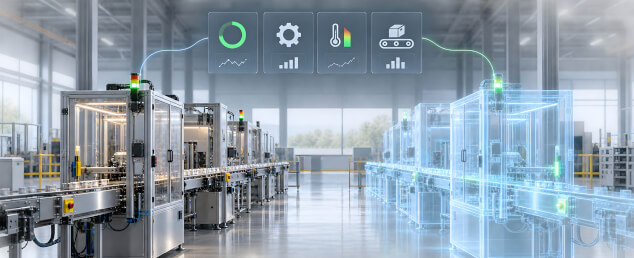
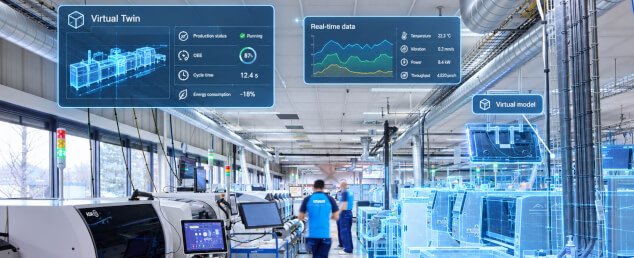
We are currently testing this on our own shop floor. On one of OMRON's twelve-stage assembly lines, production data from the machines flows into Dassault Systèmes' 3DEXPERIENCE platform. There it drives an OEE dashboard, a 3D model of the line, and a virtual twin of the line's current design.
The first gain is simple for production engineers. Previously, investigating a performance problem meant walking to the line with a USB stick, downloading log files from every stage that might be involved, and calculating OEE by hand. Gathering and analysing the data took around four hours a day. Now it is available at a login, refreshed every ten minutes. Engineers can replay a video of any hour of production to see exactly when and where OEE was lost. They can also raise a ticket with a snapshot of the data attached, so colleagues can start a root-cause analysis.
The dashboard does not replace the engineer, nor say why a stage underperformed. It shows when an issue occurred, and that tells the engineer where to go and look on the shop floor. The dashboard makes clear if we are meeting the OEE targets.
Another gain comes from comparing the real line against its virtual twin. Engineers can model alternatives, such as adding a worker, adding a robot or changing the process, and see the likely effect on OEE before spending anything. Some ideas that look like improvements can turn out, in simulation, to reduce output because of how the stages interact. Finding that out virtually is far more cost-effective than finding it out in practice. Because our production lines are built in similar ways, an improvement proven on one line can be copied to the others. The same is true of the digital environment.
Beyond data exchange
Safety is a good example of where this is heading. Factory design has traditionally treated safety as its own workstream, running alongside everything else. Through the integration of OMRON and Dassault Systèmes technologies, we are working towards safety being part of the same design and simulation environment from day one. That goes beyond systems exchanging data. It means redesigning how engineering work is done.
This is why IT/OT convergence is not only about technical integration. Manufacturers under pressure on margins, on volatile demand and from digital-native competitors need more than stable systems. Traditional IT/OT architectures were built for stability, and for a long time that was the right goal. But change is now the normal state of things, and software-defined manufacturing is built for change. That is a fundamentally different proposition.
Are we fully there? Not universally. Highly integrated IT/OT is still mainly found at large manufacturers that can absorb the investment and the organisational rethinking it requires. Small and mid-sized companies are taking steps, choosing the parts most relevant to their immediate pressures. But the direction is clear, and the gap between early movers and everyone else is widening.
Perhaps the clearest sign of real change is this: we no longer think of an IT engineer and an OT engineer working separately. The engineers working with these solutions work across both at once.
Read more about our collaboration with Dassault Systèmes.
Contact us for more information